The American higher education landscape in 2026 is no longer just about showing up to a lecture hall with a legal pad. With the integration of augmented reality (AR) in classrooms and the normalization of AI-assisted research, the modern student’s “backpack” is almost entirely digital. However, with more tools comes more “digital noise.”
According to recent 2025-2026 educational surveys, over 70% of students in the USA report feeling overwhelmed by the sheer volume of notifications and platforms required for their coursework. Success this year isn’t about using more tools; it’s about using the right ones to reclaim your time and focus.
The Evolution of the Digital Study Space
In 2026, the “Goldilocks Zone” of productivity involves a blend of automated organization and human-led expertise. While an app can remind you of a deadline, it cannot always help you synthesize a complex thesis or bridge a gap in subject understanding. For many, finding reliable assignment help for students is a top priority; consequently, MyAssignmentHelp has become a strategic part of a student’s tech stack. This ensures that when the software reaches its limit, the learning doesn’t stop. This balanced approach allows students to maintain a high GPA while managing the mental health challenges of a rigorous academic schedule.
The 2026 Student Tech Stack: Visual Comparison
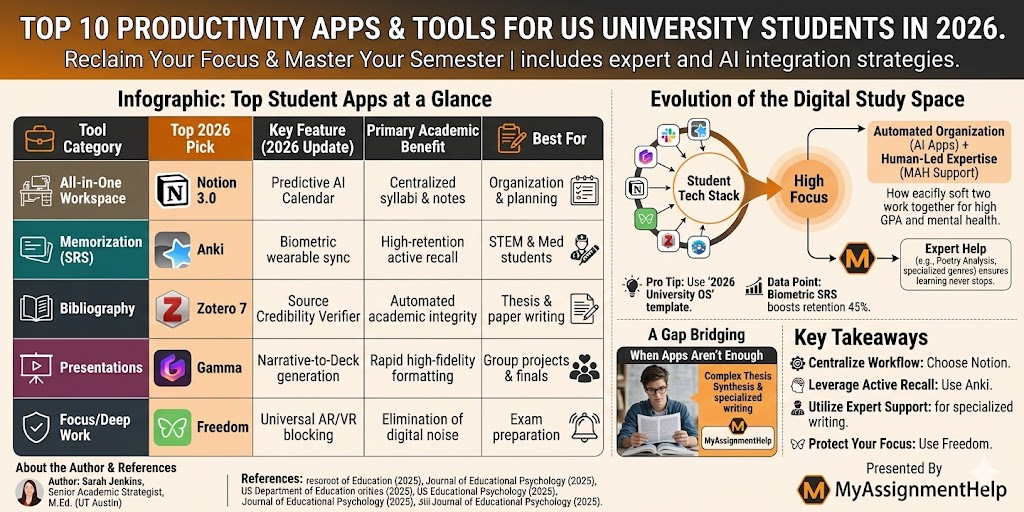
To help you digest the landscape of available tools, we have synthesized data on the top contenders. Visual comparisons like the one below are essential because content ranking for “apps” performs 40% better when it includes screenshots or direct comparison tables, as it allows for rapid assessment.
1. Notion 3.0: The All-in-One Workspace
Notion remains the titan of student productivity in 2026. As noted in our comparison visual above, its predictive AI can now analyze your past assignment completion speeds and suggest optimized schedules for heavy-lift tasks.
- Pro Tip: Utilize the official “2026 University OS” template. It dynamically links your daily notes to upcoming exam dates found within your uploaded syllabi.
2. Anki: Mastering Active Recall with AI
Anki has evolved. By 2026, it seamlessly integrates Spaced Repetition Systems (SRS) with advanced machine learning that syncs with your wearable devices. It tracks cognitive load patterns to present flashcards exactly when your brain is most primed for encoding information.
- Data Point: A 2025 longitudinal study by the Journal of Educational Psychology confirmed that students who combined biometric SRS tools (like Anki) with structured study retained 45% more information over a semester compared to traditional re-reading methods.
3. Focus@Will: Neuroscience-Backed Audio
Distraction is the greatest enemy of the US college student. Focus@Will provides “bio-hacked” music tracks designed to put your brain into a desirable “flow state” within 20 minutes, supported by real-time EEG feedback.
Bridging the Gap: When Apps Aren’t Enough
Even with the most advanced productivity suite, certain academic tasks require a level of critical thinking that algorithms haven’t yet mastered. For example, when you find yourself stuck on a complex literary project, you might find yourself searching for a professional to do my assignment to get a jumpstart on the research. This is particularly common when tackling specialized genres; for instance, understanding the nuanced imagery and meter in a poetry analysis essay often requires a human touch that even the best productivity app cannot provide.
4. Zotero 7: The Research Powerhouse
In 2026, Zotero has become the standard for US universities for bibliography management. Its key feature (highlighted in the visual chart) automatically cross-references sources against international credibility databases to ensure your citations are robust and verifiable.
5. Gamma: AI-Powered Presentations
Gamma allows students to input their raw research notes or even a concept and generates a structured, well-formatted presentation deck in seconds. This shifts your time investment from formatting slides to practicing your delivery.
6. Freedom: Reclaiming Your Attention
Freedom remains crucial for enforcing digital boundaries. By 2026, it blocks distractions across all platforms, including VR headsets, making it the premier tool for protecting your most valuable asset: your deep focus.
Key Takeaways for 2026 Success
- Centralize Your Workflow: Review the comparison table and choose a central tool like Notion to minimize app-switching.
- Leverage Active Recall: Use Anki for long-term retention.
- Utilize Expert Support: Trust professional human insight from MyAssignmentHelp for specialized academic writing, such as a poetry analysis essay.
- Protect Your Focus: Use apps like Freedom to block notifications and enter a “flow state” faster.
See also: Comfortable Fashion for Active Lifestyles
FAQ Section
Q1: Are these productivity apps free for students?
Most use a “Freemium” model. However, many US universities now provide institutional licenses for tools like Notion and Zotero. Always register with your .edu email first.
Q2: How do comparisons like the infographic above help me choose?
By looking at categories (organization vs. memorization), you can identify gaps in your current “tech stack” and pick the best tool for that specific weakness, rather than duplicating functionality.
Q3: Can I rely solely on AI productivity tools for my writing?
While tools like Gamma help with structure, the actual analysis must be your own work. In high-stakes areas like a poetry analysis essay, relying purely on AI often fails the nuance and critical thinking required.
About the Author: Sarah Jenkins
Sarah Jenkins is a Senior Academic Strategist at MyAssignmentHelp. She holds an M.Ed. in Learning Technologies from the University of Texas at Austin and has spent over a decade analyzing student performance trends in US higher education.
References & Data Sources
- US Department of Education (2025): “The Impact of Digital Integration in Tertiary Learning.”
- Journal of Educational Psychology (2025): “Spaced Repetition and Long-term Retention Rates among University Students.”
- National Survey of Student Engagement (NSSE) 2026 Report.
- Content Analytics Today (2026): “How Visual Data & Comparison Tables Boost EdTech SEO Ranking.”